WAS ambulances: From manufacturing to configuration
From manufacturing to configuration – is that really possible? In this interview with Sandra Szech, they tell us how Wietmarscher Ambulanz- und Sonderfahrzeuge GmbH (WAS for short) answered this question and how the team led by product managers Ulrich Konitzer and Andreas Fafenrot managed to implement it in a short space of time.
WAS is a leading manufacturer of ambulances and special vehicles. Vehicles for customers all over the world are manufactured at the plant in Wietmarschen to meet the individual wishes and specific requirements of customers in the best possible way.
When we met about a year and a half ago, you were facing a major challenge: moving from manufacturing to configuration. What was the deciding factor back then for you to actually make the change?
Andreas Fafenrot: As a company, we strive to be successful – to optimize production, to bring more vehicles into the field and to continuously expand our customer base. However, we have realized that it is above all the diversity of customer requirements that presents us with challenges.
Ulrich Konitzer: Every day, we created new variants that we were unable to master in terms of design, safeguarding and production. The dependencies were constantly becoming a greater challenge, everything was becoming more and more complex. One of the reasons for this is the market: the basis of the basic vehicle models that we customize has grown immensely in recent years.
And how did you discover that modularization is a key issue for you?
Ulrich Konitzer: When I went through our production facilities, I kept asking myself: why is the implementation one way in one place and completely different in another? The same functions were solved differently, e.g. through different assembly options. This is not a requirement from a customer. Why are we doing this and what is the solution? The idea of modularization is obvious.
Today you are a whole step further. The modular system is ready, the configurator is being set up and the organization is being changed accordingly. What were your success factors that enabled you to take the decisive steps in such a short time? What were your success factors that enabled you to take the decisive steps in such a short time?
Ulrich Konitzer: It was a great challenge for us to take staff away from the specialist departments in order to devote a large part of our time to the task of modularization. We went so far as to outsource the technical development.
Andreas Fafenrot: This was only possible because we combined the upcoming product revisions with the modularization. In order to achieve implementation as quickly as possible, we specified standardization to the specialists and technicians. Standardization made it possible to build up specialist knowledge, which is the basic idea and theory behind the modular system. Thanks to the specifications, we were able to involve a large group of people in the implementation. Odego Cquenz has enabled us to achieve standardization and modularization.
Ulrich Konitzer: Containing the variance and reducing the dependencies would not have been possible in this form without the tool and the support of Odego. Not only to involve outsiders. I’ve been involved for many years, but I was able to expand my knowledge of the diversity and its effects in the vehicle.
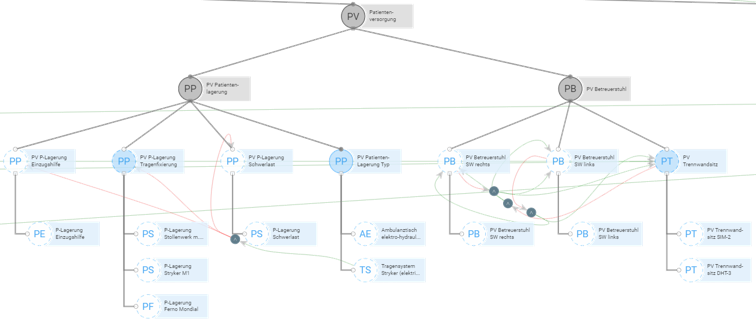
Andreas Fafenrot: Yes, that’s how we achieved precision and structure. In Cquenz, we have streamlined the products. Which variants are needed and which are unnecessary? Where does the variance lead to problems and where does it not? With these findings, it was possible to define concrete specifications for implementation for our service providers.
Ulrich Konitzer: It went all the way to implementation in the configurator. The partner who builds the configurator with us says he has rarely seen such a well-prepared model.
What presented you with unexpected challenges?
Andreas Fafenrot: In this change, it’s challenging to get everyone on board at the same time. Durch die Umstellung beim Standardisierungsprozess sind viele Diskussionen entfacht, getroffene Entscheidungen bedürfen immer wiederkehrenden Erklärungen, sowie das Verständnis differenter Sichtweisen.
Ulrich Konitzer: We were aware from the outset that this would happen. For example, contacts from Odego’s customer network also warned us about it. But it still took more effort than we had perhaps expected. We had to promote the new approach internally, and Odego helped us to explain the toolkit internally, take feedback from colleagues and also convince the “critics”.
Andreas Fafenrot: In the beginning, the approach is still very abstract for the entire organization. Many colleagues will only realize what it really means when it is put into practice. What helps us is a mutual exchange at fixed intervals throughout the entire process.
What advice can you give to other companies that may be at a similar point as you were 2 years ago?
Ulrich Konitzer: I asked myself at the beginning: Is that really possible? Can our product really be modularized? And now I would say that practically any product can be. In my opinion, only large companies that bring in experts can do this on their own. It worked for us because with Odego we have a partner at our side who eliminates “operational blindness”, looks at it from a different perspective, builds a model and knows how to implement something like this. Without this external support, it is difficult to realize this successfully. And: the team must have the ambition and be motivated.
Andreas Fafenrot: It was actually clear to me that it was possible because I had already experienced it in my professional career. Nevertheless, the unbelievable number of articles made me doubt it. A diffuse and detached variety. We had tens of thousands of articles in 48×1038 possible combinations – at this point, the data analysis provided useful preliminary work. Using Odego Analytics to show this and recognize the customer usage patterns behind it gave me the confidence that we could create equipment variants. And that we can provide sales with a product that allows us to offer our customers the individuality they need in an ambulance. We have subsequently developed the configuration model in Cquenz. This will probably always be the step to success: breaking down the product in Cquenz to such an extent that you gain deep and comprehensive knowledge about your product. This is the solution path into the configurator, into procurement and production. For me, the key moment was when we completed the configuration model in Cquenz. That’s when I realized that this is definitely feasible and can be implemented.
Thank you, Ulrich and Andreas, for these insights into your key experiences and for allowing us to be part of this success story.