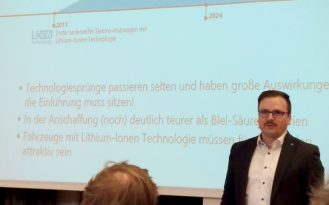
Jungheinrich: Data-based product management for the rollout of lithium-ion technology
From the first electrically powered forklift truck in 1953 to the first

Definition
DEFINITION OF COMPACT PRODUCT CONFIGURATION:
Product configuration is the process of using standard components from a modular system to create customized customer products. Unlike traditional variant models, configuration here is done “on demand”—in real time, system-supported, and with precision.
Benefits
Tools

Tools
Procedure
Past sales figures and future trends are analysed to determine the focus of your modular system.
Existing product structures are analysed, modular function blocks are defined and mapped in sequence.
Cquenz is used to model configuration logic: module dependencies, valid combinations and configuration paths.
Before tool landscapes are converted, we test configurability with a lightweight Excel prototype. This allows the team to develop an idea of the future process and derive requirements for future configuration software.
Transfer to CPQ solutions (e.g. Tacton, SAP VC) ERP, PLM, CAD or CRM systems, taking into account individual requirements and in consultation with the relevant experts for subsequent product configuration services.
Industry cases
A manufacturer of oil filtration systems reduced its design workload by 60%. Cquenz provided a clear configuration logic — the basis for efficient quotation preparation.
In the field of specialty vehicle manufacturing, Cquenz has demonstrated that the transition from a made-to-order production model to a configuration-based model is indeed possible—and supports the rapid implementation of a CPQ tool.
USP
Odego understands the challenges faced by a wide range of industries and brings over a decade of hands-on experience to the table. Our expertise spans:
This industry expertise enables us to quickly identify configuration opportunities and develop concrete solutions.
With Cquenz, the tool developed by Odego GmbH, we offer a unique system for developing and simulating configurable modular systems. It is the only tool on the market that can not only map a complete configuration model but also simulate it in its entirety—including:
This allows both technical feasibility and economic benefits to be validated simultaneously—a clear advantage for investment decisions and system implementations.
Configuration starts with the product—not with the CPQ system. That’s why our support begins with the development of the modular product structure. We help with:
Visualization and version control for transparent teamwork
Introducing a configurable product system requires not only technology but also a new way of thinking. That is why we support not only the implementation but also the transformation:
On this basis, companies can, for example, realign their modular approach, consolidate their product range, or systematically tap into new market opportunities. The goal is a balanced product portfolio that both addresses customer needs and can be managed efficiently internally.
Consequently, the results obtained are verified using data—not just in theory, but directly based on the configuration logic that has been developed. This makes it possible to:
demonstrate in a measurable and transparent way—even in the early stages of a project.
Product configuration is the process of systematically assembling individual products from predefined modules and rules.
It guides users through selection rules, automatically creates technical documents, and ensures valid, implementable product variants.
CPQ stands for Configure-Price-Quote. It automates configuration, price calculation, and quotation creation in real time.
It enables tailor-made products from a modular system that is specifically designed for each company in such a way that it reduces costs and increases efficiency and competitiveness.
Product configuration consulting supports companies in building a configurable product portfolio – from analysis and modular development to integration into CPQ or ERP systems. The Cquenz tool helps to model and validate configuration logic and successfully manage change within the team.
Newsletter subscription
Adding {{itemName}} to cart
Added {{itemName}} to cart