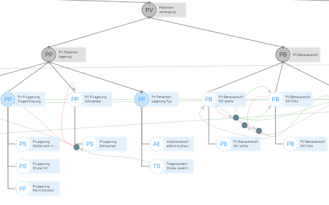
Modular product architecture is a strategic approach to designing technical products that helps companies efficiently manage development, production, and variant diversity. It provides a generic structure that
applies to all product variants,
is functionally structured, and
forms the stable framework of a product—
regardless of customer-specific characteristics.
Definition
What is modular product architecture?
At its core, modular product architecture is the systematic division of a product into individual, clearly defined modules. These modules each perform specific functions, are connected to each other via standardized interfaces, and can be combined in different variations. The modular design approach enables a component-based architecture in which products remain customizable without requiring a separate development project for each version.
This structured form of product development forms the basis for scalable and maintainable diversity – regardless of whether it involves machines, components, devices, or complex systems.
Benefits
Advantages of modular product architecture
The benefits of a modular product architecture can be measured in many areas. Not least, it contributes to cost reduction through modularity by enabling variants to be developed, manufactured, and maintained more efficiently:
Basis for reuse, standardization, and systematic modularization
Transparency regarding complex product systems
Rapid elimination of product variants
Flexible production processes and reduced time-to-market
Standardized interfaces for mechanical, electrical, and digital components
Reduction of development effort and risks, because the effects of changes are limited to individual modules
Approaches
How to structure the product into modules
A key element in implementation is the correct structuring of the product. This involves several perspectives: A well-thought-out architecture takes all these aspects into account, enabling a modular product kit that actually works in day-to-day business.
Functional
Modules form logical functional units that provide concrete benefits to the user.
Interface-driven
Optimal module interfaces are created where stable, standardizable interfaces are possible
Configuration
Variant creation must be mappable using clearly defined characteristics and rules.
Process-driven
Module interfaces must fit the logic of purchasing, assembly, warehousing, or service.
Procedure
Modular product architecture – how it works
Unlike conventional tools, which only look back, Cquenz offers “future product mining” in five steps. Thanks to an individually tailored data collection strategy, there are no input requirements for data quality. The result: a fact-based system for evaluation and optimization—long before high costs arise.
1
Functions
Functional structuring of the product and identification of central modules
2
Diversity
Definition of characteristics and rules for variant creation
3
Modules
Analysis of process-driven module drivers along the supply chain
4
Interfaces
Analysis and evaluation of technical interfaces
5
Effects
Simulation and evaluation of variant diversity, quantities, and costs along the process chain
Tool
What tools are needed?
A data-based, transparent approach is crucial for successful implementation. The Odego tool Cquenz supports the entire process: from initial structuring and variant modeling to simulation and evaluation of costs, quantities, and delivery times. It enables component-based modeling of complex products and creates the basis for consistent decisions—from product development and purchasing to manufacturing.
In plant and special machine construction, modular architectures allow customer-specific designs to be efficiently derived – with a high degree of reusability.
The defense industry uses modular product architectures as the basis for systems engineering and long-term further developments across system boundaries.
In vehicle manufacturing and logistics, modular structures support testing, validation, and rapid production ramp-up—especially for complex variants and new launches.
Electrical engineering and component manufacturers benefit from high reuse rates and the resulting economies of scale—an important basis for economies of scale and cost-effectiveness.
A modular product architecture is a generic, functionally structured concept that applies to all variants of a product and enables reuse and flexibility.
Modular product architecture offers great potential in all industries where technically complex and highly varied products are developed, e.g. mechanical engineering, medical technology, the defense industry, logistics, vehicle manufacturing, and component manufacturers.
Assessing design alternatives for modular product architecture across all product variants is challenging—a data- and model-based approach helps to master this task.